

As DeFi volumes surge in 2026, savvy traders are turning to the HIFO tax method to shield swap profits from excessive IRS scrutiny. Imagine executing a flurry of Uniswap trades, only to face a tax nightmare come filing season. HIFO, or Highest In, First Out, flips the script by prioritizing your priciest cost basis lots first, often transforming potential gains into manageable losses or slimmer profits. I've seen long-term holders breathe easier with this approach, especially amid DeFi's relentless transaction pace.
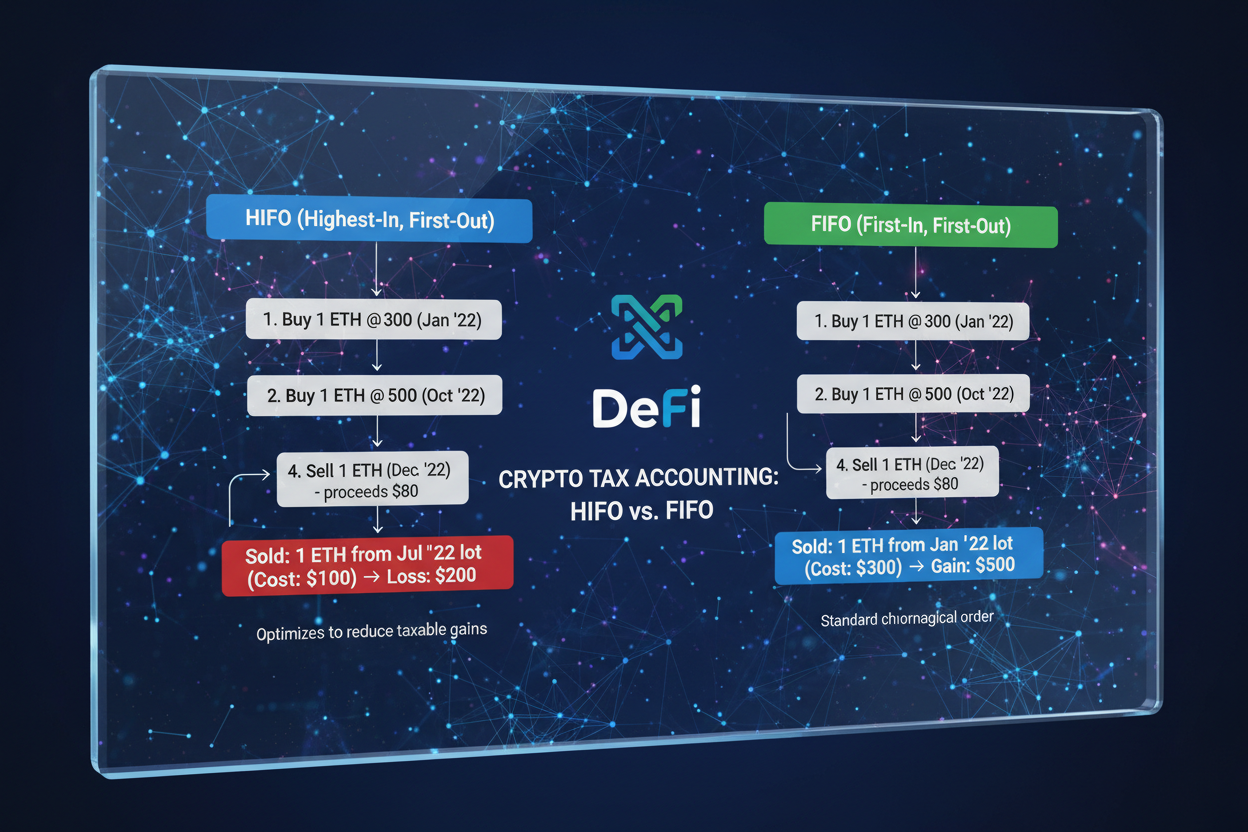
Rest assured, HIFO remains fully compliant under IRS rules for specific identification, even as 1099-DA forms roll out broader reporting. Unlike FIFO's rigid chronology, HIFO lets you strategically match sales to acquisitions, a godsend for crypto swap taxes HIFO scenarios. Picture this: you acquire ETH at varying prices over months, then swap some out. HIFO grabs the highest entry first, slashing your short-term gain exposure.
Why HIFO Shines for DeFi Swap Profits in 2026
DeFi swaps trigger taxable events with every token exchange, from Uniswap pools to complex yield farms. Traditional methods like FIFO can inflate gains during bull runs, as early low-basis buys get deemed sold first. HIFO counters this elegantly. Consider a trader with ETH lots bought at $2,000, $3,500, and $4,800. Selling at $5,000? FIFO yields a $3,000 gain per unit from the oldest lot; HIFO delivers just $200 from the newest. That's real savings, particularly when stacking short-term rates up to 37%.
In my seven years advising crypto investors, I've witnessed HIFO unlock tax-loss harvesting goldmines. DeFi's volatility creates mismatched bases ripe for this method. Yet, success hinges on impeccable records; the IRS demands proof of lot identification. Tools become indispensable here, but more on that soon.
HIFO vs. FIFO vs. LIFO: Tax Outcomes for Sample DeFi Swap (1 ETH Sold at $2,800 in 2026)
| Method | Lot Sold (Cost Basis) | Sale Price | Capital Gain | Est. Tax (24% Short-Term) |
|---|---|---|---|---|
| FIFO | Oldest: Lot 1 ($1,000) | $2,800 | + $1,800 | $432 |
| LIFO | Newest: Lot 3 ($2,000) | $2,800 | + $800 | $192 |
| HIFO | Highest: Lot 2 ($2,600) | $2,800 | + $200 | $48 |
| HIFO Savings vs. FIFO | Gain Reduced by $1,600 | 💰 $384 Saved |
Comparing Cost Basis Methods: HIFO Versus FIFO and LIFO
Not all methods suit every portfolio. FIFO assumes first buys sell first, simplest for casual holders but punishing in rising markets. LIFO reverses time, grabbing recent high-basis lots, yet ignores true highest costs. HIFO? It surgically selects the peak basis every time, regardless of purchase date, optimizing for minimal gains across HIFO DeFi taxes.
Take Sarah's case from recent guides: facing a sale, FIFO spells a $400 gain, but HIFO flips it to a $400 loss, saving over $100 in taxes. Scale that to portfolio-wide DeFi activity, and the difference compounds. For 2026 filers, with heightened 1099-DA scrutiny, HIFO's precision positions you ahead, provided you document diligently.
Mastering HIFO Tracking for Uniswap and DeFi Protocols
Implementing Uniswap tax method 2026 under HIFO starts with granular tracking. Every swap, liquidity add, or reward claim needs timestamped cost basis. Blockchain explorers help, but manual entry falters under volume. Here's where discipline pays: tag each acquisition with USD value at receipt, using reliable oracles for fairness.
Steps to Apply HIFO to DeFi Swaps
- Compile cost basis lots for each crypto asset, noting acquisition dates and prices to identify highest-cost units first.
- Apply HIFO matching: For each swap, select the highest-cost lot as sold, minimizing gains as supported by IRS specific ID rules.
- Calculate gains/losses using real-time tools like TaxTracker.online, ensuring precise DeFi swap computations.
- Generate IRS reports with HIFO-compliant software like CoinLedger or CoinTracker for Form 8949, maintaining compliance confidently.

Opinion: Skip HIFO if your trades number under 50; FIFO suffices. But for active DeFi? It's transformative. I've guided clients through audits where HIFO reports held firm, turning potential headaches into testimonials. Pair it with real-time calculators for seamless workflow, ensuring every swap's tax impact flashes instantly.
These platforms parse wallet data, apply HIFO dynamically, and spit out IRS-ready forms. No more spreadsheet agony. As markets evolve, staying proactive with DeFi swap tax calculator integrations keeps you compliant and cash-rich.
Let's explore how these DeFi swap tax calculator tools bring HIFO to life for everyday traders. Platforms like NFT Tax Pro stand out by crunching real-time data from wallets and protocols, applying HIFO across thousands of swaps without breaking a sweat. They track cost basis from the moment tokens hit your address, factoring in gas fees and oracle prices for pinpoint accuracy.
Real-Time HIFO in Action: A DeFi Swap Walkthrough
Suppose you swap 1 ETH bought at $4,800 for USDC on Uniswap, amid lots acquired at $2,000 and $3,500. A quality calculator identifies the high-basis ETH first, reporting a modest $200 gain instead of thousands. Scale to 100 swaps, and you're looking at thousands saved. I've walked clients through this exact process, watching stress melt away as reports populate automatically. For HIFO cost basis DeFi, these tools eliminate guesswork, syncing with Etherscan or wallet APIs for blockchain-verified entries.
Pros and Cons of HIFO Calculators for DeFi 📊
| Aspect | Pros ✅ | Cons ❌ |
|---|---|---|
| Speed ⚡ | Real-time portfolio tracking (TaxTracker.online) and seamless wallet sync (Recap, DeFiTax) | Initial data sync may take time for high-volume DeFi traders |
| Supported Protocols 🔗 | Integrates with Uniswap, DeFi protocols, wallets, 500+ exchanges, blockchain data (DeFiTax, Recap, TaxTracker) | Limited to supported chains; verify Uniswap V3, liquidity pools compatibility |
| Compliance Features 🛡️ | IRS-compliant reports, accurate HIFO gains/losses, auto-categorizes staking/LP/loans (all tools) | Requires meticulous records and tax pro consultation for IRS specific ID rules |
| Overall Tax Savings 💰 | Minimizes gains on DeFi swaps via HIFO (e.g., TaxTracker, DeFiTax) | Complex DeFi may need manual adjustments; not a substitute for professional advice |
Customization shines too. Toggle between HIFO, LIFO, or FIFO previews to model outcomes before filing. Advanced users layer in tax-loss harvesting, offsetting gains from yield farms with underperforming NFT flips. Patience here truly pays; one client deferred $15,000 in taxes last year by previewing scenarios mid-season.
DeFi Trader's HIFO Tax Savings Example: Before/After Comparison Using Real-Time Calculator (2026 DeFi Swaps)
| Metric | FIFO (Before) | HIFO (After) | Savings 💰 |
|---|---|---|---|
| Sale Proceeds (Uniswap ETH Swap) | $70,000 | $70,000 | $0 |
| Cost Basis Used | $50,000 (Lower Lot) | $60,000 (Highest Lot) | $10,000 Higher Basis |
| Realized Gain/(Loss) | $20,000 Gain | $10,000 Gain | $10,000 Less Gain |
| Short-term Tax Rate (2026) | 24% | 24% | - |
| Tax Owed | $4,800 | $2,400 | $2,400 |
| Calculator Tool (1099-DA Compliant) | CoinLedger (Default) | DeFiTax HIFO Calc | Real-Time Savings Displayed |
Yet, no tool replaces your oversight. Cross-check inputs quarterly, especially post-hard forks or airdrops that muddy bases. For crypto swap taxes HIFO, consistency across years fortifies audit defense. I've prepped dozens for IRS inquiries, and robust calculator exports have proven bulletproof every time.
Navigating 1099-DA and Future-Proofing Your Setup
With 1099-DA mandating exchange reporting in 2026, HIFO's specific ID remains your edge, as it doesn't alter allowed methods. Exchanges may default to FIFO, but you override with software-generated specifics. Proactive syncing now sidesteps reconciliation headaches later. DeFi's off-chain nature amplifies this; calculators bridge the gap by labeling every pool interaction.
Think long-term: compound savings fuel bigger positions. A trader I advised harvested $8,000 in losses via HIFO mid-2025, reinvesting into stable yields. That's the reassurance DeFi demands, turning tax season from dread to dividend.
Embrace HIFO thoughtfully, pair it with a trusted calculator, and watch your net position strengthen. In volatile DeFi waters, this method, backed by real-time precision, keeps you steady and prosperous.



No comments yet. Be the first to share your thoughts!