
What changed in NFT tax 2026
The 2026 filing season marks a structural shift in how the IRS tracks digital assets. For years, compliance relied on self-reporting, where taxpayers calculated gains and losses from wallet-to-wallet trades without third-party verification. That era is ending. The IRS has introduced Form 1099-DA to standardize reporting for digital asset transactions, moving the burden of initial data collection from the individual to the broker.
Form 1099-DA requires digital asset brokers to report proceeds from sales and exchanges directly to the IRS and to taxpayers. This change applies to transactions involving NFTs, cryptocurrency, and other digital assets processed through regulated platforms. If you traded NFTs through a centralized exchange or a compliant marketplace in 2025, you will likely receive this form by mid-February 2026.
This shift is why 2026 is considered a watershed year for NFT tax compliance. The IRS now has a standardized dataset to cross-reference against your tax return. Discrepancies between the 1099-DA data and your Schedule D filings will trigger automated audits. The focus is no longer on whether you owe taxes, but on whether your reported figures match the broker's reported figures.
You must reconcile these new forms with your existing records. If you traded NFTs on decentralized platforms that do not issue 1099-DA forms, you remain responsible for self-reporting those transactions. However, the baseline for compliance has raised significantly. The IRS expects accurate, broker-verified data for all taxable events, making preparation essential before the filing deadline.
Gather your transaction records
You cannot reconcile what you cannot see. Before the IRS issues its new Form 1099-DA, you must assemble a complete ledger of your NFT activity. This data serves as your primary defense against discrepancies, ensuring that your self-reported figures match what the government receives from brokers and marketplaces.
Start by exporting data from every exchange and marketplace where you traded. Major platforms like OpenSea, Blur, and Magic Eden provide CSV exports of your transaction history. Download these files immediately, as policy changes or platform sunsets can sometimes restrict historical access. Treat these exports as your raw source material; do not rely on third-party summaries yet.

Log into every platform where you bought, sold, or traded NFTs. Locate the "Export" or "History" section and download the full CSV or JSON transaction history. Include all years you held or traded assets, as the IRS may request historical context.
Exchange data often misses peer-to-peer transfers or gas fee payments. Use a blockchain explorer like Etherscan or Solscan to export your wallet’s full transaction history. Alternatively, use a portfolio tracker to sync your wallet address, ensuring you capture every mint, burn, and transfer.
Once your personal records are complete, wait for the IRS to distribute Form 1099-DA. This new form will report proceeds from digital asset brokers. Compare the totals on your 1099-DA against your exported CSVs. Any difference between your records and the IRS form must be explained and documented in your tax filing.
Keep these records in a secure, backed-up folder. If the IRS questions a transaction, your ability to prove your cost basis and holding period depends entirely on these raw files. Without them, you may be forced to use unfavorable assumptions, such as the highest possible cost basis, which increases your tax liability.
Calculate gains for collectors
NFTs are treated as property by the IRS, meaning every sale triggers a taxable event. To calculate your capital gains or losses, you need two numbers: the cost basis (what you paid) and the amount realized (what you sold it for). The difference between these figures determines your tax liability.
Determine your cost basis
Your cost basis is the total amount you spent to acquire the NFT. This includes the purchase price plus any transaction fees, such as gas fees paid on the blockchain. If you acquired the NFT through a trade, use the fair market value of the item you gave up at the time of the trade.
Calculate the amount realized
The amount realized is the total proceeds from the sale. This is the sale price minus any selling fees or commissions charged by the marketplace. If you received cryptocurrency in exchange, use the fair market value of that crypto at the exact moment of the transaction.
Apply the correct tax rate
The tax rate depends on how long you held the NFT before selling it.
- Short-term: Held for one year or less. These gains are taxed as ordinary income, using your standard federal income tax bracket.
- Long-term: Held for more than one year. These gains are taxed at preferential long-term capital gains rates (0%, 15%, or 20%), depending on your total taxable income.

Collect all records of purchases, sales, and trades. Include dates, prices, and gas fees from your wallet history or a tax software export.

For each sale, subtract marketplace fees and gas costs from the total sale price to find the net amount realized.
Subtract your cost basis from the net amount realized. A positive result is a gain; a negative result is a loss.
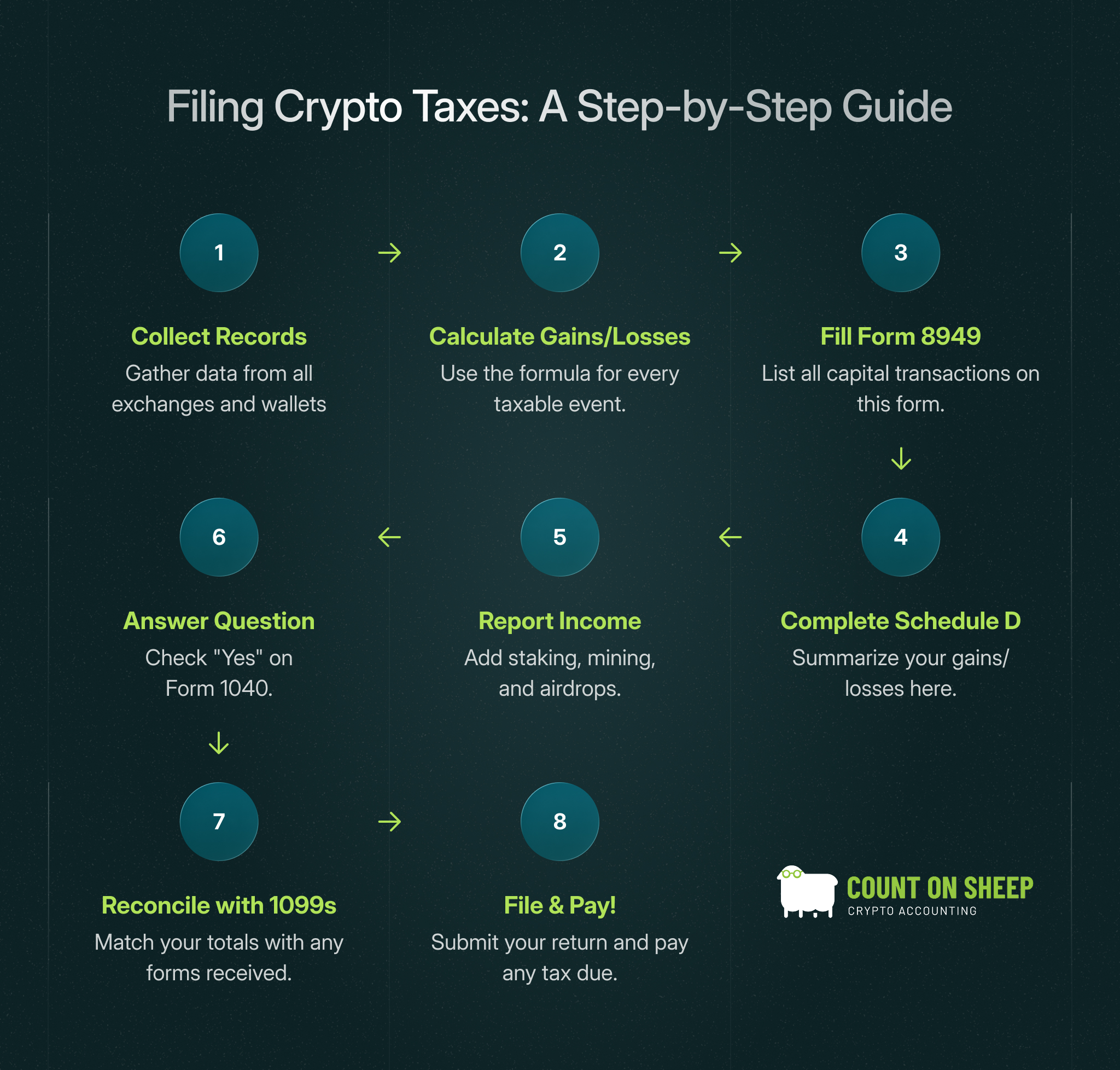
Check the date between acquisition and sale. If it is over 365 days, apply long-term rates; otherwise, use short-term ordinary income rates.
Keep a detailed log of every transaction. The IRS requires accurate reporting of digital asset sales, and failing to report NFT gains can lead to penalties. Use Form 8949 to report these transactions on your tax return.
Report creator income and royalties
Creators pay ordinary income tax on NFT sales, not capital gains. The IRS treats revenue from minting and selling your own work as self-employment income. This applies to the initial sale price and any royalties you earn from secondary market trades.
Collectors pay capital gains tax when they sell. Creators pay ordinary income tax on every dollar they receive. This distinction is critical because ordinary income rates (up to 37% in 2026) often exceed the 28% collectible rate applied to investors.
Use this table to compare how the two groups are taxed.
| Taxpayer | Income Type | 2026 Rate | Primary Form |
|---|---|---|---|
| Creator | Ordinary Income | Up to 37% | Schedule C |
| Collector | Capital Gains | 0-28% | Schedule D |
Royalties are taxed as ordinary income when received. If your smart contract automatically pays you 5% on every resale, that amount is added to your gross receipts. You must report this income on Schedule C.
Deduct business expenses to lower your tax bill. Costs like minting fees, gas fees, and marketing expenses are deductible against your creator income. Keep detailed records of these costs.
File Schedule C with your Form 1040. Report your gross receipts from NFT sales and royalties. Subtract your allowable business expenses to find your net profit. This net profit is subject to both income tax and self-employment tax.
Creators should consult a tax professional to ensure proper classification of royalties and expenses.
Handle AI-Generated NFT Collections
Taxing AI-generated art requires separating the code from the copyright. The IRS treats digital assets as property, but the origin of the asset determines how you report the income. When you mint and sell a collection created by an AI model, you are generating taxable income at the point of sale.
First, determine if the AI output is copyrightable. The U.S. Copyright Office currently refuses to register works created entirely by AI without human authorship. This means you cannot claim exclusive copyright on the raw output. However, if you significantly modify the output or curate the collection, you may hold rights to the specific arrangement or enhancements.
Next, classify the income. If you are the creator selling your own AI-generated work, the proceeds are typically self-employment income. You must report this on Schedule C. If you are trading AI-generated NFTs as an investor, the gains are capital gains. Be precise here, as the distinction affects your tax rate and deduction eligibility.
Finally, track your costs. AI generation often involves subscription fees for software or credits per image. These expenses are deductible business costs if you are operating as a creator. Keep receipts for your AI tool subscriptions and any marketplace fees to reduce your taxable profit.
Finalize your 2026 tax filing
Before you submit, ensure every NFT transaction is accounted for. The IRS treats NFTs as property, meaning every sale, trade, or mint triggers a taxable event. Missing a single transaction can lead to penalties or an audit.
Complete your checklist
Verify these items before hitting submit:
-
Gather all transaction records from wallets, exchanges, and marketplaces.
-
Calculate cost basis for every NFT sold or traded.
-
Determine if any NFTs qualify as collectibles (higher tax rate).
-
Confirm your filing deadline: April 15, 2026 1.
Use the right forms
Report your transactions on Schedule D and Form 8949. If you received a 1099-DA from a broker, ensure the data matches your records. Discrepancies between your filings and IRS copies are a common trigger for audits.
Submit on time
Late filings incur interest and penalties. If you need more time, file Form 4868 by the April 15 deadline to get an automatic six-month extension. Do not wait until the last minute; processing delays can add stress to an already complex process.
Nft tax 2026 common: what to check next
These questions address the most frequent points of confusion for creators and investors navigating the 2026 tax landscape.
Do you have to pay taxes on NFTs?
Yes. The IRS treats NFTs as property, meaning every sale, trade, or swap is a taxable event. If you sell an NFT for more than you paid, you owe capital gains tax. If you receive an NFT as payment for work, it is taxable as ordinary income at its fair market value on the day you received it.
What happened to NFTs in 2026?
The market has matured significantly. While trading volume is lower than the 2021 boom, the remaining projects are more selective and utility-focused. This shift means fewer speculative trades, but the tax rules remain the same: any disposal of the asset triggers a tax obligation, regardless of whether the project is "hype" or "utility."
Are NFTs worth anything in 2026?
Value is now tied to utility rather than speculation. Many NFTs serve as access keys for software, gaming assets, or membership passes. From a tax perspective, this utility doesn't change the filing requirement, but it does affect how you determine the fair market value when calculating gains or losses.
Will crypto be taxed in 2026?
The biggest change is Form 1099-DA. Digital asset brokers must now report transaction proceeds to the IRS. This means your taxable NFT activity will likely be pre-filled in your tax software, reducing the chance of missed reporting. You still need to verify that the reported basis matches your actual purchase price.
No comments yet. Be the first to share your thoughts!