
How the IRS treats NFTs
The IRS classifies NFTs as property, applying existing capital gains rules to digital collectibles. This means every sale, trade, or exchange triggers a taxable event that must be reported on your tax return.
Most NFTs fall under the "collectibles" category, subjecting long-term gains to a maximum 28% tax rate rather than the standard 15% or 20% rates for stocks. Short-term gains are taxed as ordinary income.
Calculate your capital gains or losses
To report NFT activity accurately, determine the exact gain or loss for every taxable event. The IRS requires you to track the cost basis against the value received at the time of the transaction.
The core formula
The calculation follows a standard structure used for all digital asset transactions:
Fair Market Value (FMV) at Sale − Cost Basis = Capital Gain/Loss
- Fair Market Value (FMV): The dollar value of the NFT at the moment it is sold, traded, or disposed of. Use the price in USD at the exact time of the transaction.
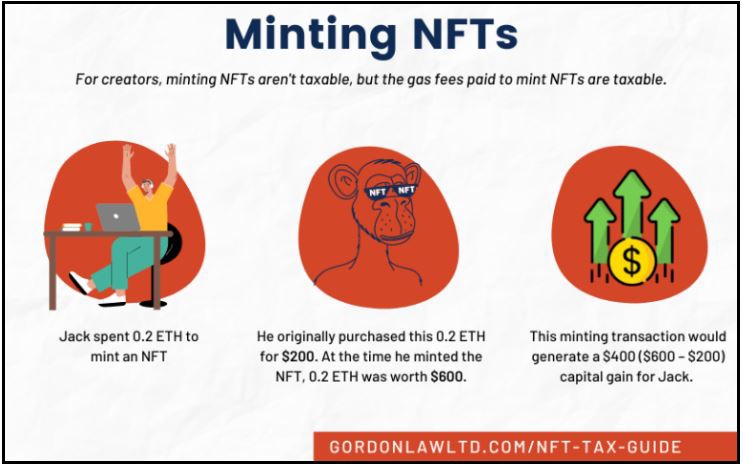
- Cost Basis: The original amount you paid to acquire the NFT, including gas fees and marketplace transaction fees. If you mined or created the NFT, the basis is the fair market value when it entered your wallet.
- Capital Gain/Loss: The difference between the two. A positive number is a gain; a negative number is a loss.
Short-term vs. long-term rates
The holding period significantly impacts your tax liability. The IRS distinguishes between assets held for one year or less and those held for more than one year.
- Short-term capital gains: Applies to NFTs held for one year or less. These are taxed at your ordinary income tax rate, which can be as high as 37%.
- Long-term capital gains: Applies to NFTs held for more than one year. These typically benefit from lower preferential rates (0%, 15%, or 20%), depending on your taxable income.
The "collectibles" exception
A critical nuance for NFT investors is that the IRS may classify certain NFTs as "collectibles" rather than standard capital assets. If an NFT is deemed a collectible, the maximum long-term capital gains rate jumps to 28%, regardless of your income bracket.
This classification often applies to digital art, trading cards, or virtual land that resembles tangible collectibles. Because the threshold for this classification can be subjective, you should document the nature of the NFT and how it functions in your records. When in doubt, consult a tax professional to determine the correct classification for your specific assets.
Track transactions across multiple wallets
Aggregating NFT data across different wallets and exchanges is often the most difficult part of 2026 tax season. Most collectors use several wallets—such as MetaMask, Phantom, or hardware wallets—alongside multiple exchanges to buy, sell, or trade digital assets. The IRS expects you to report the total gain or loss from all these sources, regardless of where the transaction occurred.
Failing to link these separate data points can result in incomplete reporting or accidental double-counting. A missed transaction on a secondary wallet might look like an unreported event, while a duplicate import from two different sources could inflate your cost basis.
Follow this sequence to consolidate your NFT tax data accurately.
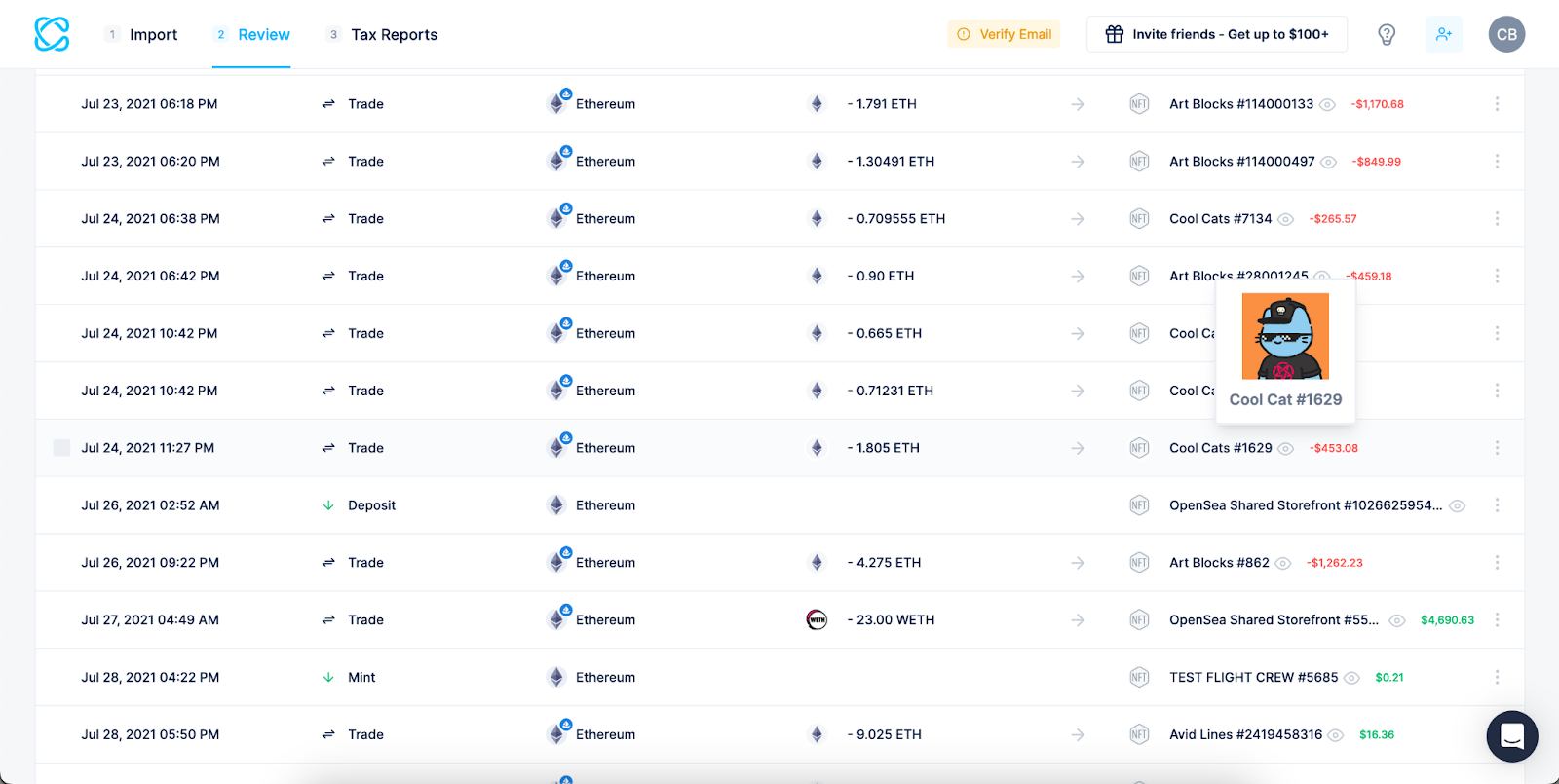
Log into every exchange where you traded NFTs. Download the full transaction history for the tax year in CSV format. Ensure you capture all buy, sell, and trade records, as these form the baseline for your cost basis calculations.
Use a specialized crypto tax platform to scan your non-custodial wallets. Enter each wallet address to pull on-chain data for mints, transfers, and peer-to-peer sales. This step captures activity that exchanges do not report, ensuring you have a complete picture of your holdings.
Cross-reference the exchange exports with the wallet data. Many platforms automatically flag transactions that appear in both datasets. Manually verify any discrepancies, ensuring you do not count the same sale twice or miss a cross-chain bridge that might appear differently on each ledger.

Review the final aggregated report to ensure all NFTs are accounted for. Check that the cost basis for each asset reflects the original purchase price plus any gas fees. This verified total is what you will use to calculate your capital gains or losses for the 2026 filing season.
Identify taxable versus non-taxable events
The IRS treats NFTs as property, which means every disposition is a potential taxable event. You must track the value of the NFT at the time of the transaction and compare it to your cost basis. Misclassifying a taxable trade as a non-taxable transfer is a common error that leads to underreported gains.
Not every interaction with an NFT triggers a tax bill. The distinction often lies in whether you have disposed of the asset or simply moved it within your own control. Understanding this difference helps you avoid filing unnecessary forms or missing obligations on actual sales.
The table below summarizes the most common NFT transactions and their tax treatment under current federal guidelines.
| Transaction | Taxable? | IRS Reporting | Key Detail |
|---|---|---|---|
| Sell NFT for fiat (USD) | Yes | Schedule D | Capital gain or loss based on sale price minus cost basis. |
| Trade NFT for another NFT | Yes | Schedule D | Treated as a barter transaction; value of received NFT determines basis. |
| Swap ETH for ETH | No | None | Moving between compatible wallets or swapping identical tokens is not a disposition. |
| Gift NFT below annual limit | No (for giver) | None | Giver has no tax liability; recipient takes donor's cost basis. |
| Mint your own NFT | No | None | Creating a token is not a sale; tax applies only when you later sell it. |
Prepare your tax documents for filing
The 2026 filing season will be messy, with the IRS treating digital assets as a minefield for most investors. To navigate this, you must transfer your calculated gains and losses to the correct tax forms. This process centers on Schedule D and Form 8949, where every NFT sale, trade, or disposal requires precise documentation.
Step 1: Gather your 1099-DA and transaction logs
Before you open tax software, ensure you have the official IRS Form 1099-DA. Starting with 2026 transactions, brokers must report both gross proceeds and adjusted cost basis for covered digital assets. If you traded on self-custody wallets or decentralized exchanges, you must manually compile this data using your transaction logs. Do not rely on memory; use a consistent spreadsheet or crypto tax software to aggregate every buy, sell, and swap.
Step 2: Complete Form 8949 for each transaction
Form 8949 is where you report each specific transaction. List every NFT sale or trade on this form, detailing the date acquired, date sold, proceeds, and cost basis. If you have fewer than 100 transactions, you can list them individually. For larger portfolios, you may sum transactions of the same type, but you must still report the total on Form 8949. Accuracy here is critical, as errors can trigger audits.
Step 3: Transfer totals to Schedule D
Once Form 8949 is complete, transfer the totals to Schedule D. This form summarizes your capital gains and losses. Short-term gains (assets held one year or less) are taxed as ordinary income, while long-term gains (held more than one year) receive preferential tax rates. Ensure the totals from Form 8949 match Schedule D exactly. Any discrepancy will flag your return for review.
Step 4: File your tax return
Attach Schedule D and Form 8949 to your Form 1040. Double-check that all NFT-related income is reported, including airdrops, staking rewards, and sales. Keep copies of all records, including transaction hashes, wallet addresses, and valuation screenshots, for at least seven years. If your situation is complex, consult a tax professional experienced in digital assets.
Pre-filing checklist
-
Verify you have received Form 1099-DA from all relevant brokers.
-
Reconcile wallet data with transaction logs to ensure no trades are missed.
-
Confirm your cost basis method (FIFO, LIFO, or Specific ID) is applied consistently.
-
Review for wash sale implications, especially if you rebought similar NFTs quickly.
-
Verify you have received Form 1099-DA from all relevant brokers.
-
Reconcile wallet data with transaction logs to ensure no trades are missed.
-
Confirm your cost basis method (FIFO, LIFO, or Specific ID) is applied consistently.
-
Review for wash sale implications, especially if you rebought similar NFTs quickly.
Common NFT tax mistakes to avoid
Avoiding penalties starts with accurate record-keeping. Most taxpayers stumble on three specific areas: cost basis calculations, airdrop reporting, and DeFi interactions. Correcting these errors before filing prevents audits and ensures you pay the correct capital gains tax.
Ignoring gas fees in cost basis
Your cost basis is the total amount you paid to acquire an NFT. This includes the purchase price plus all transaction fees, known as gas fees. Many investors exclude these fees, which artificially inflates their reported profit when the NFT is sold. To calculate your correct basis, add the gas fees paid at minting or purchase to the initial cost. This reduces your taxable gain. The IRS treats these fees as part of the acquisition cost, not as a separate expense.
Missing airdrops and staking rewards
Receiving an NFT through an airdrop or staking reward is a taxable event. The value of the NFT on the day you receive it becomes your ordinary income. You must report this amount on your tax return, even if you did not pay for the token. Failure to report these assets can trigger IRS scrutiny. Keep records of the value at the time of receipt to establish your basis for future sales.
Failing to report DeFi interactions
Interacting with decentralized finance (DeFi) protocols often triggers taxable events. Swapping tokens, providing liquidity, or claiming rewards can create capital gains or losses that must be reported. The IRS may treat certain NFTs as "collectibles," which are taxed at a maximum long-term capital gains rate of 28%. This higher rate applies if the NFT is considered a collectible under IRS guidelines. Ensure your tax software accounts for these specific interactions to avoid underreporting your liability.
No comments yet. Be the first to share your thoughts!