
NFT tax 2026: what changed for filers
The 2026 tax season marks a structural shift in how the Internal Revenue Service tracks digital asset transactions. For the first time, digital asset brokers are required to report transaction data directly to the IRS using the new Form 1099-DA. This mandate moves the burden of proof from the taxpayer to the platform, fundamentally altering the compliance landscape for NFT holders and traders.
Previously, many crypto investors relied on the absence of broker reporting to avoid tracking every trade. That era has ended. Under the new rules, exchanges and marketplaces must provide detailed records of sales, purchases, and disposals. This data includes cost basis and gain or loss information, which the IRS will receive alongside your tax return. The goal is to close the gap between on-chain activity and tax filings, ensuring that capital gains are reported accurately.
While the reporting infrastructure is new, the underlying tax treatment of NFTs remains consistent with past guidance. The IRS continues to classify NFTs as property. This means standard capital gains rules apply: short-term gains for assets held one year or less are taxed as ordinary income, while long-term gains for assets held longer may qualify for lower rates. However, some rare or collectible NFTs may be subject to the 28% collectibles tax rate if held for more than a year.
Tax experts describe the 2026 filing season as a "watershed" moment, noting that the transition will be complex for many investors. The sudden influx of broker-reported data may reveal discrepancies between what taxpayers previously reported and what the IRS now sees. Filers should review their transaction history carefully and reconcile any differences before submitting their returns. Ignorance of the new reporting requirements is not a valid defense against audits or penalties.
How the IRS Classifies NFTs for Tax Purposes
The IRS does not have a separate tax code specifically for NFTs. Instead, it applies existing digital asset guidance to treat them as property. This classification means that every sale, trade, or disposal of an NFT triggers a taxable event. The critical variable determining your tax liability is whether the IRS categorizes your specific NFT as a standard capital asset or as a "collectible."
For most standard digital assets, long-term capital gains rates are 0%, 15%, or 20%, depending on your taxable income and filing status. However, the IRS treats certain NFTs as collectibles under Section 408(m) of the Internal Revenue Code. This category includes art, antiques, and other tangible or intangible items held for investment. If your NFT falls into this category, the maximum long-term capital gains tax rate rises to 28%. This higher bracket applies regardless of your income level, potentially creating a significant tax liability for high-value digital art sales.
The distinction matters most for long-term holdings. If you sell an NFT within one year of acquiring it, the profit is taxed as ordinary income, subject to your standard federal income tax bracket (10% to 37%). This rule applies uniformly to both standard assets and collectibles. The difference only emerges when you hold the asset for more than one year, at which point the preferential capital gains rates kick in, but at different maximums depending on the classification.
To understand the financial impact, compare the potential tax rates for standard digital assets versus those classified as collectibles.
| Asset Type | Held ≤ 1 Year | Held > 1 Year |
|---|---|---|
| Standard Capital Asset | 10%–37% (Ordinary Income) | 0%, 15%, or 20% |
| Collectible (e.g., Digital Art) | 10%–37% (Ordinary Income) | 0%, 15%, 20%, or 28% |
Determining whether your NFT is a collectible often depends on its primary use and characteristics. NFTs representing digital art, music, or trading cards are frequently scrutinized under the collectibles rule. In contrast, NFTs that function primarily as access tokens, utility keys, or governance rights may be treated as standard capital assets. Because this classification can be ambiguous, taxpayers should document the intended use and nature of each NFT to support their reporting position.
Taxable NFT transactions you must report
The IRS treats NFTs as property, meaning every disposition triggers a potential tax liability. Distinguishing between taxable events and non-taxable movements is critical for accurate reporting. Taxable events occur when you sell, swap, or receive NFTs as income. Non-taxable events include purchasing with fiat or moving assets between wallets you own.
Sales and Dispositions
Selling an NFT for fiat currency, another cryptocurrency, or even a different NFT constitutes a taxable disposition. You must calculate capital gains or losses based on the difference between the fair market value at the time of sale and your cost basis. Short-term gains (held one year or less) are taxed as ordinary income, while long-term gains may qualify for lower rates or the 28% collectibles rate if the NFT is deemed a collectible by the IRS [src-serp-3].
Swaps and Exchanges
Exchanging one NFT for another, or swapping an NFT for any other cryptocurrency, is treated as a sale of the original asset. This is a common point of confusion; many users believe swapping is non-taxable because they did not convert to cash. However, the IRS views this as realizing value on the original NFT, requiring you to report the gain or loss on that specific transaction.
Staking Rewards and Airdrops
Receiving NFTs as rewards for staking, liquidity provision, or airdrops is taxable as ordinary income at the fair market value on the date of receipt. This value becomes your new cost basis. If you later sell these NFTs, the gain or loss is calculated from this initial value, not from zero.

Tracking cost basis for multiple wallets
Managing NFT tax liability becomes exponentially difficult when assets are spread across several wallets. Each wallet may contain different collections acquired at different times and prices. Without a unified ledger, you risk miscalculating your cost basis, leading to either overpaying taxes on gains you didn’t realize or underreporting income during an audit.
The IRS treats each NFT transaction as a taxable event. When you sell an NFT, you must subtract its original acquisition cost (cost basis) from the sale price to determine the capital gain. If you bought the same NFT collection in multiple wallets at different price points, you need to identify which specific token was sold to apply the correct basis. This is known as specific identification, and it requires meticulous record-keeping.
Consider a scenario where you hold five Bored Ape Yacht Club tokens. One was purchased for 50 ETH, another for 80 ETH, and three for 120 ETH each. If you sell one today for 100 ETH, your tax liability depends entirely on which specific token you sold. Selling the 50 ETH token results in a 50 ETH gain, while selling the 120 ETH token results in a 20 ETH loss. Without precise tracking, you cannot claim the loss or accurately report the gain.
Failure to track basis across wallets can trigger IRS audits. The 2026 filing season is expected to be particularly rigorous for digital assets. Experts warn that discrepancies between wallet activity and reported income are a primary red flag for examiners. To avoid this, use dedicated crypto tax software that aggregates data from all your wallets and exchanges. These tools can automatically calculate cost basis using FIFO (First-In, First-Out) or specific identification methods, ensuring your filings match your on-chain history.
Compliance checklist for 2026 filings
The 2026 filing season presents distinct challenges for NFT owners, particularly with new digital asset reporting requirements. Experts describe the upcoming season as "messy" and a "minefield" for investors who have not kept meticulous records. To navigate this, you must align your internal data with the new IRS Form 1099-DA and ensure every transaction is accounted for before the deadline.
Export a complete ledger of all NFT activity from every wallet and exchange you used in 2025. This includes buys, sells, swaps, and airdrops. Do not rely on memory; the IRS will cross-reference your filings with broker reports.
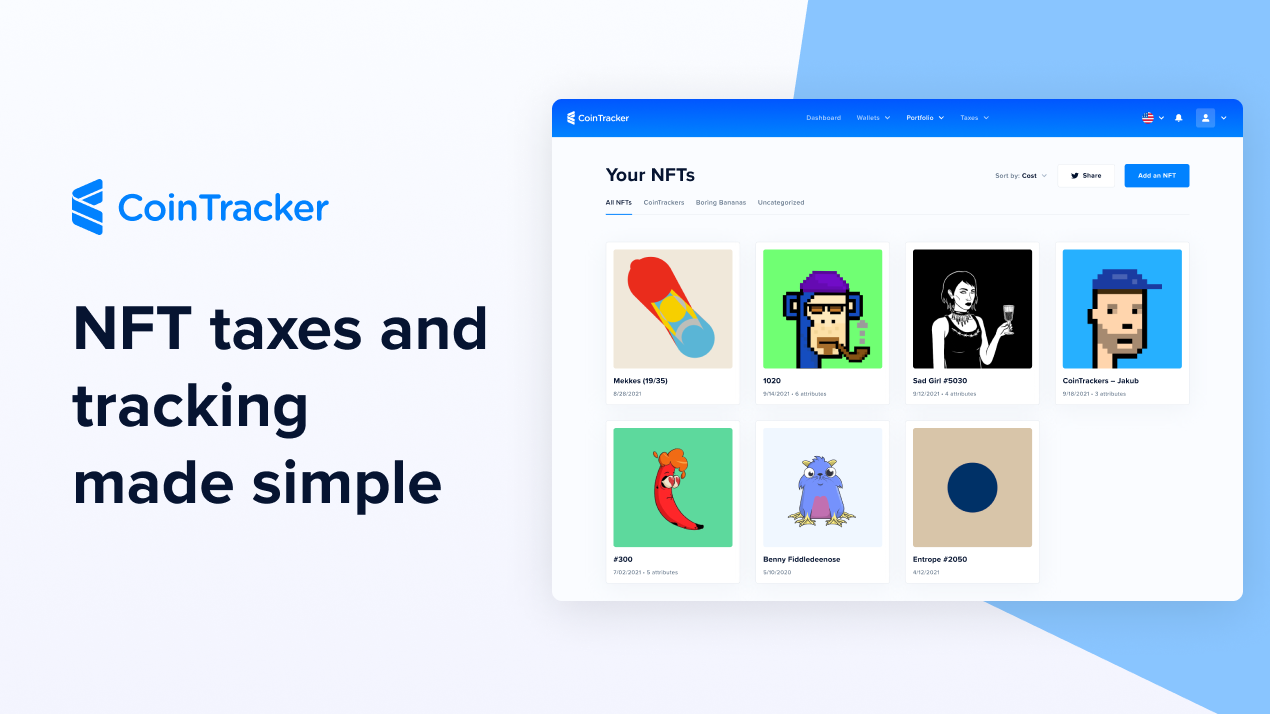
Determine the cost basis for each NFT sold or exchanged. Short-term gains (held one year or less) are taxed as ordinary income, while long-term gains may qualify for lower rates. Be aware that certain NFTs may be classified as "collectibles," subject to a 28% tax rate.

Once issued, compare the information on your 1099-DA forms against your personal ledger. If the broker reports a sale you do not recognize, or if the cost basis is incorrect, you must file an amended return or attach an explanation to your Form 8949.

Given the complexity of digital asset tax law, engage a CPA or tax attorney who specializes in cryptocurrency. They can help you navigate specific deductions, wash sale ambiguities, and ensure your final return withstands IRS scrutiny.
Keeping accurate records is the only way to avoid penalties in this new regulatory environment. Treat your NFT portfolio with the same financial discipline as a traditional investment account.
Common questions about NFT taxes in 2026
Tax rules for digital assets are rarely black and white, leading to frequent confusion among collectors and creators. Below are answers to the most common questions regarding NFT taxation and market status in 2026.
Understanding these distinctions helps you avoid costly errors when filing your return.
No comments yet. Be the first to share your thoughts!